Reject Travis Scott Nike drops: compare crashing resale data
The Travis Scott sneaker economy is not dead. Let’s kill that lazy headline right now.
Darius Rollins, Chief Hip-Hop Critic & Culture Editor·Updated: June 27, 2026·15 min read
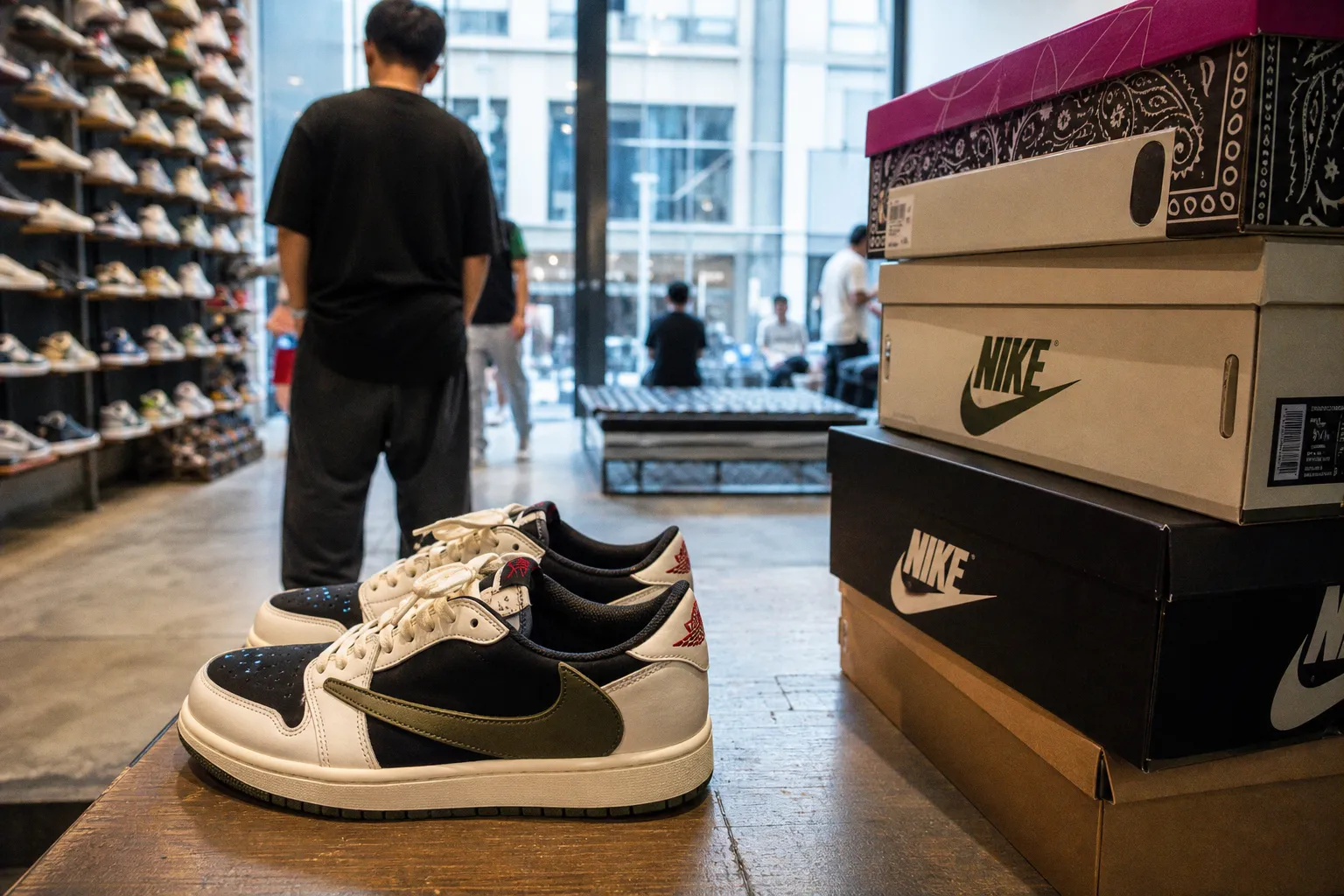
The hard number is the tell: major Travis Scott Nike releases can still open with premiums sitting 200% to 1000% above retail, but the correction window has gotten uglier. A 20–40% slide within three months is not some rare market hiccup anymore. It is part of the rhythm. The question is not “Is Travis still hot?” The question is how to check compare crashing resale data before you let somebody’s Discord cook group, TikTok flex, or fake scarcity language talk you into paying the top of the bubble.
And yes, I’m saying “reject” some Travis Scott Nike drops — not because the shoes are trash, not because the man lost cultural cachet overnight, and not because every pair is destined to brick. Reject the reflex. Reject the panic buy. Reject the resale gospel that treats every reverse Swoosh like it came down from Mount Sinai with a guaranteed ROI stitched into the tongue.
Deconstructing the hype bubble: the 500% markup trap
The “Travis Scott Effect” is real. Anybody pretending otherwise is doing contrarian cosplay. The 2019 Travis Scott x Air Jordan 1 High OG changed the temperature around rapper sneaker collaborations in the modern resale era. It had the right silhouette, the right chaos, the right celebrity gravity, the right earthy palette, and the one design move simple enough for a kid to draw from memory: the reversed Swoosh.
That shoe became a market turning point because it did what all historic streetwear objects do: it collapsed identity, scarcity, and status into one clean visual. You didn’t need to explain it. The shoe announced itself from across the block.
But every cultural moment becomes a spreadsheet eventually. That is where the game gets nasty.
The pre-release and immediate post-release window is where hype turns predatory. Prices spike because nobody knows the true supply, everybody screenshots the highest asks, and resellers start speaking in absolutes. “These won’t go lower.” “Last chance.” “Market is drying up.” Same tired sermon. Different thumbnail.
The bubble usually forms from four forces moving at once:
1. Retail scarcity is real, but incomplete. Nike does not disclose exact internal stock numbers for these releases, so the public market fills the silence with rumor. Rumor is gasoline.
2. Early pairs distort the chart. Before full delivery lands, there are fewer confirmed pairs available, which makes high early sales look like “true market value.” They are often just rich impatience.
3. Clout buyers don’t price-shop. The first wave is not always rational. Some buyers are paying to post first, not to buy well.
4. Seller inventory hits in waves. Once pairs land from SNKRS, boutiques, backdoors, and delayed shipping, the ask wall thickens. That is when the pretty chart starts limping.
The Travis Scott x Air Jordan 1 Low “Olive” from 2023 gave the market a clean lesson. It had the ingredients: Jordan 1 Low, wearable color story, Travis branding, massive demand, mainstream visibility. It also saw a significant price drop after release, with resale values stabilizing well below the first hype-driven peak. That does not make the “Olive” a failure. It makes it a perfect case study in how hype premiums get corrected when supply actually shows its face.
The first price is emotion. The settled price is the market clearing its throat.
This is where sneaker talk gets sloppy. People say “prices crashed” when they mean “prices stopped being delusional.” A 30% drop from a stupid pre-release peak is not the same thing as a brick. But if you bought at that peak because some reseller with a ring light told you the shoe was “only going up,” the difference feels academic while your money is lying on the floor.
Reading market depth: how to spot a crashing silhouette
If you want to know how to check compare crashing resale data, stop staring at the last sale like it’s scripture. Last sale is a headline. Market depth is the article.
StockX gives you signals through bid/ask behavior, last sale data, and market depth. That matters because a sneaker price does not crash only when the last sale drops. It starts cracking when sellers pile up above the market and buyers refuse to chase.
Here’s the simple read: if asks keep undercutting each other and bids stay flat or fall, the shoe is not “consolidating.” It is hunting for a lower floor.
A clean crash pattern usually looks like this:
1. Pre-release ask inflation. Sellers list high because supply is thin and buyers are anxious. You’ll see fantasy asks masquerading as market value.
2. Release-day volatility. Last sales jump around because pairs are moving fast and buyers are reacting emotionally.
3. Delivery-week ask wall. More pairs arrive. Sellers compete. Undercutting begins.
4. Bid fatigue. Buyers stop raising bids because they can see inventory swelling.
5. New floor discovery. The market settles 20–40% below the early peak, sometimes more depending on stock, sizing, and overall demand.
This is where the difference between a wearable collectible and a resale trap becomes obvious. If the shoe has real long-term demand, the floor stabilizes. If the shoe was powered mostly by launch noise, the floor keeps sagging every time new inventory appears.
Look at size runs, too. Sneaker media loves one clean average price because it makes a nice chart. Real buyers know the money is in the sizing. A men’s 11 can behave differently from a 7.5. Extended women’s sizing can carry separate demand. Big sizes sometimes move with fewer pairs and higher volatility. Small sizes can get weird when international demand enters the picture. If you’re only reading the global average, you’re reading the market with one eye closed.
And please, stop treating the highest ask as a flex. A $1,200 ask on a shoe that last sold at $680 with bids at $610 is not the market. That is a seller writing fan fiction.
What the data is actually telling you
| Signal | Healthy resale demand | Crashing resale setup |
|---|---|---|
| Last sale | Moves within a tight range after release | Drops repeatedly after delivery waves |
| Lowest ask | Holds firm or rises slowly | Sellers undercut every few hours |
| Highest bid | Buyers move up to meet supply | Buyers sit low and wait sellers out |
| Market depth | Thin enough that one sale can move price | Heavy ask wall with many pairs stacked |
| Platform spread | StockX, GOAT, eBay roughly align | One platform shows inflated asks while others soften |
| Time since release | Stabilizes after initial chaos | Keeps sliding after the “hype week” ends |
That table is not financial advice. Sneakers are not Treasury bonds with suede. It is just the grown-up way to read a market that has been marketed to death.
StockX bids vs. GOAT dynamic pricing: why one platform is never enough
StockX, GOAT, Flight Club, eBay — each one shows you a different angle of the same street fight.
StockX is useful because its bid/ask structure makes tension visible. You can see what sellers want and what buyers are actually willing to pay. That gap is the truth serum. A tight spread means the market agrees. A wide spread means somebody is lying to themselves, usually the seller.
GOAT and Flight Club operate with dynamic pricing that reflects real-time supply and demand, but the presentation can feel less transparent than a clean bid/ask board. That does not make it useless. It makes it another lens. GOAT can show you how retail-style marketplace behavior responds when demand shifts fast. Flight Club, especially with its consignment legacy and premium buyer base, can sometimes carry higher visible pricing because its customer is not always the same kid grinding bids on StockX at 2 a.m.
eBay adds another wrinkle because auction behavior, seller reputation, authentication flow, and negotiated offers can create price pockets you won’t see on StockX. The catch is obvious: condition, photos, seller history, and listing language matter more. A “new” pair with a damaged box, missing lace bag, or questionable receipt story should not be treated like a clean deadstock comp.
The mistake is using one platform to confirm what you already want to believe. That is how hypebeast culture turns into a streaming farm for bad decisions: repeat the same signal, inflate the same number, pretend the crowd is wisdom.
A resale price is not real until buyers on multiple platforms agree to stop flinching.
There’s also the fee structure, which quietly shapes behavior. StockX seller fees often sit around 8–10%, while GOAT commonly runs a 9.5% seller commission plus cash-out costs. Those fees matter because sellers are not only thinking about gross sale price. They are thinking about what lands in the account after the platform takes its bite. A seller who bought too high may resist cutting ask because the fee math turns a small loss into a bloody one. That stubbornness can keep asks artificially high even while actual demand weakens.
So when you compare platforms, don’t just ask, “Where is it cheapest?” Ask:
- Are completed sales moving down, or are only asks moving down? A lower ask is pressure. A lower completed sale is confirmation.
- Do bids follow the last sale, or are they sitting beneath it? If bids refuse to rise, the buyer side is not convinced.
- Is one platform carrying a fantasy premium? If StockX shows a softer market while Flight Club sits high, you may be looking at audience difference, not value.
- Are prices changing across multiple sizes or only isolated ones? One weird size is noise. A full size-run slide is a trend.
- Did a big delivery wave just hit? Post-shipping supply can punch a chart in the mouth.
That is the actual answer to how to check compare crashing resale data: triangulate. StockX for bid/ask pressure. GOAT for dynamic market behavior. eBay for messy real-world comps. Then wait long enough for the first emotional wave to burn off.
The 2023–2024 saturation problem
The 2023–2024 period has exposed a tension Nike and Travis Scott cannot fully finesse: the more often you feed the market, the harder it is to keep every meal tasting rare.
This does not mean the collaboration is cooked. It means the market has matured. Or, less politely, the audience has been trained.
For years, Travis Scott Nike drops benefited from a near-mythic release aura. The product hit like an event. Fans, resellers, collectors, casual buyers, and celebrity watchers all piled into the same doorway. But when a collaboration expands across more lows, more colorways, more adjacent silhouettes, and more repeated design language, the market starts sorting. It no longer treats every pair as a grail. It ranks them.
The Jordan 1 High OG from 2019 sits in a different chamber because it helped define the whole run. A later low-top colorway may still be strong, still wearable, still culturally loud — but it carries a different burden. It has to compete not just against other Nike releases, but against previous Travis pairs. The archive becomes the enemy.
That is how saturation works in streetwear. It doesn’t always announce itself as failure. It shows up as selectivity.
Buyers start asking sharper questions:
- Is the colorway actually better, or just familiar?
- Does the silhouette have independent demand without the Cactus Jack stamp?
- Are people buying to wear, or only to flip?
- Does the shoe add to the Travis design language, or recycle it?
- Is the resale premium based on scarcity, or just old reputation?
The “Olive” correction mattered because it proved that even a desirable pair could get humbled by market mechanics. That was not a scandal. That was gravity. And gravity has been working overtime in sneaker resale since the pandemic-era money rush cooled off.
The bigger streetwear market also changed. Buyers got smarter. Some got poorer. Some got bored. Some got burned holding pairs they thought would age like Bordeaux. The pandemic flipped half the internet into amateur resellers, and the aftermath left a lot of closets looking like failed inventory rooms. When liquidity dries up, hype has to prove itself with actual demand.
You can see the same mood across rap fashion trends more broadly. Artist merch does not automatically sell out just because the rapper had a hot single. High fashion rap campaigns do not automatically create street-level credibility. Jewelry flexes hit different when everyone knows the advance hasn’t recouped. The culture still loves status objects, but it has less patience for obvious extraction.
That is the line Travis Nike is walking now: still culturally powerful, but no longer immune to correction.
Real value vs. artificial scarcity
The most dangerous word in sneaker resale is “rare.”
Rare compared to what? Rare in which size? Rare before or after shipping? Rare because Nike made fewer pairs, or rare because sellers are temporarily holding inventory off-market? Rare because people love the shoe, or rare because everyone is waiting for someone else to blink?
Artificial scarcity is the old streetwear trick, and it still works because emotion moves faster than analysis. But real value has different fingerprints. Real value survives after the launch circus leaves town.
A Travis Scott Nike drop has real cultural value when the shoe keeps appearing in the wild without looking like a costume. When stylists use it without forcing it. When artists wear it after the campaign cycle. When collectors hold it because it completes a story, not because they’re praying for a price spike. When the silhouette stands even if you mentally remove the celebrity logo.
Artificial scarcity, meanwhile, sounds like this: “Don’t sleep.” “Pairs drying up.” “This is the next Mocha.” “Market about to explode.” The resale community loves prophecy because prophecy is free inventory marketing.
If you are buying to wear, the calculus is cleaner. Pay what the shoe is worth to you after comparing the market. If the premium feels stupid, wait. In many recent hype cycles, patience has been the only undefeated buyer strategy. Not always, but often enough to make panic look foolish.
If you are buying to flip, you need to be even colder. The spread has to survive fees, shipping, taxes, failed authentication risk, market movement, and time. That last one gets ignored. Holding a pair for six months to make lunch money is not a hustle. It is storage cosplay.
Here’s the brutal breakdown of where people overpay:
| Buyer mistake | Why it hurts | Better read |
|---|---|---|
| Buying during pre-release peak | Supply is thin and fear is loud | Wait for delivery-week data |
| Trusting last sale alone | One sale can distort perception | Compare bids, asks, and depth |
| Ignoring platform fees | Profit disappears after commission | Calculate net, not gross |
| Treating every Travis pair equally | Archive hierarchy matters | Rank silhouette, colorway, and timing |
| Believing scarcity rumors | Stock numbers are not public | Watch inventory behavior instead |
| Following social hype | Clout moves faster than price truth | Cross-check StockX, GOAT, and eBay |
And let me be clear: nobody outside the machine has perfect visibility. Nike does not publish total stock numbers for these drops. Resale platforms do not give you a holy, manipulation-proof “fair market value.” High-volume sellers can influence perception. Fake and replica pairs exist in the broader ecosystem, and nobody can honestly claim a precise percentage shaping secondary-market data. If someone speaks with too much certainty, check their cart. They may be holding pairs.
That skepticism is not anti-sneaker. It is pro-culture. The culture deserves better than being treated like a liquidity pool with better outfits.
The rejection is not about Travis. It is about discipline.
Rejecting Travis Scott Nike drops does not mean pretending the collaboration has no juice. That would be unserious. Travis still has one of the most effective sneaker design languages of the modern rap era. The earthy palettes, flipped branding, utilitarian mood, and Cactus Jack mythology still move people. He has built more than merch. He built a visual economy.
But visual economies can get overleveraged.
The market is telling us something plain: the automatic premium is under pressure. The early bubble is less trustworthy. The post-release correction is more visible. The difference between a grail and a tax on impatience is now measurable if you stop looking at sneaker pages like they’re gospel.
So the play is simple. Don’t buy the announcement. Don’t buy the first screenshot. Don’t buy the loudest ask. Learn the floor. Watch the spread. Compare platforms. Let the delivery wave hit. If the price holds after that, maybe the shoe has real legs. If it folds, you just saved yourself from becoming somebody else’s exit liquidity.
This is bigger than one rapper, one Swoosh, one olive nubuck upper. It’s the current state of hip-hop streetwear: culture still creates the heat, but the market has learned how to weaponize that heat against the same people who made it matter. The way out is not cynicism for sport. It is literacy.
And if you need a reminder of how fast online attention mutates into buying pressure, just watch the broader churn of viral news, social trends, and entertainment noise at Viral Press for a few minutes. The same mechanics live in sneaker drops: velocity, repetition, status, panic.
My verdict: Travis Scott Nike is still a heavyweight franchise, but the blind flip is washed. The people still paying pre-release fantasy prices in this market are not ahead of the curve. They are feeding it.
Wear what you love. Study what you buy. And when the chart starts coughing, don’t call it hate.
Call it the market finally rapping on beat.