This contract mistake cost a rapper his masters: check yours
Every year, dozens of breakthrough rappers sign their first major deal believing they are about to become the next superstar.
Darius Rollins, Chief Hip-Hop Critic & Culture Editor·Updated: June 18, 2026·13 min read
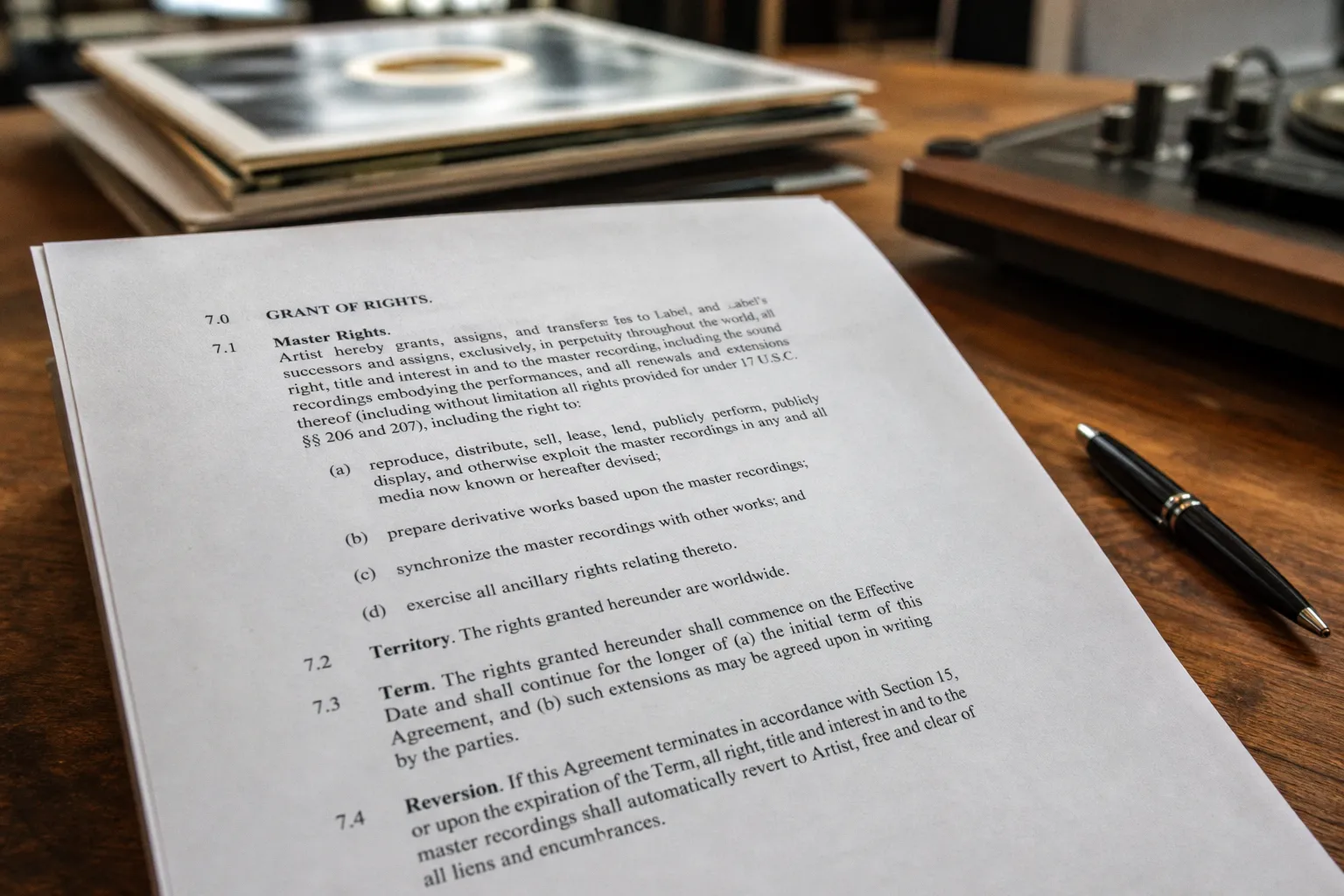
Your master is the recording. Your publishing is the song. Confuse the two and you sign your legacy to someone else's balance sheet.
This is the audit nobody handed you — and the one your A&R is not going to walk you through. Let's run it.
The Hidden Trap of Work-for-Hire Clauses
A "work-for-hire" clause sounds like legalese you'd skim past on page 30-something. It is not skim material. In plain English, it is the contractual switch that reclassifies you — the artist, the creative, the name on the track — as a hired service provider. The work you create belongs to the person who hired you. In a recording context, that means the label becomes the legal author of the sound recording from the moment the mic turns on. You keep your name on the cover, your face on the thumbnail, your verse on the song. The bank account tied to that master is not yours.
The mechanism is brutally elegant. The label is not stealing from you. You agreed to it. Somewhere on page 7 of a 40-page deal, the language says the recording is a "work made for hire" under copyright law, and just like that, you never owned it at all. Not 50 percent. Not a 30 percent reversion after fifteen years. Zero.
This is not a relic of the 1990s major-label playbook. It still runs through modern distribution deals, joint ventures, and the kind of 360 deals that get pitched to artists with a buzz but no infrastructure. The rapper thinks they are licensing a track. They signed a deed. By the time they realize it, the song has eighty million streams and the recoupment math means they will not see a royalty check for years, if ever.
The cheat code is auditing your contract before you sign. Specifically, search the document for these phrases: "work made for hire," "work-for-hire," "employee-for-hire arrangement," or any variation that assigns authorship to a party that is not you. If those phrases appear in a recording context — meaning you, the artist, are delivering the performance — push back. Hard. Because once that signature lands, the chain of ownership has been broken at the source.
Work-for-hire is not the end of the world if it is paired with a tight grant-of-rights clause and a reversion trigger. But by itself, naked, it is the single fastest way to turn your catalog into someone else's collateral.
Decoding the Grant of Rights: Territory, Duration, and Scope
Every recording contract contains a "grant of rights" clause. This is the section that defines what, exactly, you are giving away. Three variables matter: territory, duration, and scope. If the section is over your head, this is the part where an entertainment lawyer earns their fee — and where your cousin who "knows a guy in the music business" earns his irrelevance.
Territory is the geographic footprint of the deal. "Worldwide" is what your A&R told you they wanted. "Worldwide, in perpetuity" is what they actually wrote. Read those two words separately — "in perpetuity" — and understand that they mean the rights do not return to you at any defined point in your lifetime, your children's lifetime, or your grandchildren's lifetime. In many jurisdictions, copyright on a sound recording runs 70 years after the death of the author. If the label is the author — see work-for-hire above — that 70-year clock belongs to them, not you.
Duration is how long the grant lasts. This is where reversion language hides, and where most young artists fail to negotiate. The standard deal, the one that is printed and waiting on the desk, often grants rights for the full term of the copyright. That is the most aggressive version. A more artist-friendly version defines a fixed number of years — typically 10 to 20 — after which the masters revert to the artist. If your contract does not have a reversion clause at all, you are funding someone else's retirement plan with your catalog.
Scope is the range of uses the label can exploit. Streaming. Sync. Physical. Sampling licenses. Compilation inclusions. Public performance royalties in their capacity as master owner. If the grant is broad enough, you cannot even use your own verse on a future project without permission. If the grant is narrow — say, digital distribution only, with a defined five-year window — you preserve optionality. The label gets what they need to recoup their investment. You keep what you need to build a career after them.
A clean, fair grant-of-rights clause spells out exactly which rights are being transferred, to whom, for how long, in what territory, and reserves everything else to the artist. If your contract hands the label a blank check with no expiration date and no geographic boundary, you are not in a partnership. You are a tenant in your own building.
Masters vs. Publishing: Why the Distinction Defines Your Long-Term Revenue
The single biggest confusion in the recording industry — and the one that costs emerging rappers the most — is the difference between master rights and publishing rights. They are not the same thing. They are not interchangeable. Owning one does not mean you own the other. Treat them like two separate bank accounts that both pay out from the same song, and you are closer to the truth.
Master rights refer to the sound recording — the specific audio file, the specific performance, the specific mix. When a streaming service licenses a song, they pay a master royalty to whoever owns that specific recording. If you own 100 percent of your masters, every stream pays you, less the platform's cut and any producer splits negotiated on a track-by-track basis. Master ownership is what artists mean when they say "I own my music" — and it is the cleanest path to long-term catalog value.
Publishing rights refer to the underlying composition — the lyrics, the melody, the song itself. This is split between a songwriter's share (typically 50 percent) and a publisher's share (the other 50 percent, often assigned to a publisher in exchange for an advance and administration). Whenever that song gets covered, sampled, synced to film, played on terrestrial radio, or streamed, the publishing royalty fires. Different right. Different money. Different owner.
Here is where it gets dangerous for young rappers who do not have a lawyer reading the contract. An artist can sign a deal that gives them 100 percent of their publishing back (or splits it favorably with a co-writer or small publisher) and still own zero percent of the masters. They will earn money from the song as a composition. They will earn nothing from the recording as a recording. Two different revenue streams. Two different stacks of paper that an artist has to manage separately for the rest of the catalog's life.
This is why independent artists who self-distribute through platforms that let them keep 100 percent of master rights are building catalogs that compound in value over time — and why artists on traditional label deals often find that their most-streamed records are not on their personal net worth statement.
| Aspect | Master Rights | Publishing Rights |
|---|---|---|
| What it covers | The specific sound recording and its audio | The underlying composition (lyrics, melody) |
| Who earns from it | Whoever owns the master (label or artist) | Songwriter + publisher split |
| Revenue triggers | Streams, downloads, sync of the recording, masters-licensing | Covers, samples, film/TV sync, radio play, performance royalties |
| Best-case ownership | 100% for indie artists via modern distribution | 50% songwriter's share retained indefinitely |
| Industry trap | Work-for-hire, perpetual grants, missing reversion | Publishing advances with cross-collateralization |
A modern licensing deal with a 50/50 master split sounds generous until you run the numbers. At scale, the label's half of a streaming catalog is worth more than the entire publishing half of that same catalog. That is the math the pitch deck rarely shows.
If you do not own the master, you do not own the hit. You licensed the hit. The difference shows up on your accountant's desk in year three.
Leveraging Reversion Clauses to Reclaim Your Catalog
The reversion clause is the closest thing the modern artist has to a buyback option on their own work. It says, in effect: after a defined period of time or a defined financial milestone, the masters revert from the label back to the artist. Done right, it is a slow-release valve that lets your catalog come home to you in 10 to 20 years. Done wrong, it is a clause so heavily negotiated against you that the reversion conditions are functionally unreachable.
I have read contracts with reversion clauses that require the label to recoup 150 percent of all expenses — including future marketing commitments the artist has no visibility into — before any reversion kicks in. I have seen clauses that tie reversion to a stream count so high the catalog would have peaked twice over by the time it triggered. The clause exists on paper. It is real. It does not work.
What a working reversion clause looks like: a defined period — 10 years from release date, or 15 years from execution, depending on how the deal is structured — after which masters return to the artist no matter what. Alternatively, a reversion tied to specific, achievable benchmarks: a defined stream count, a defined revenue threshold, a defined date. Whichever lands first.
The savvy play is to negotiate reversion language at the front end, not the back end. Once the deal is signed, the label has zero incentive to give back what they already own. The conversation has to happen before the ink dries, ideally with an entertainment lawyer who has read a reversion clause before — which, if you are a rising artist without one, is the actual problem we should be talking about.
For artists who do not have access to high-end legal counsel, the alternative is to build reversion-equivalent protection into the deal structure itself. Go independent. Use a distribution platform that lets you retain 100 percent of masters and runs on a service fee rather than an ownership transfer. License the masters to a label for a defined window rather than assigning them outright. Each of these structures preserves the reversion principle without requiring you to wait a decade for contractual language to fire.
Navigating the Trade-off Between Upfront Advances and Long-Term Equity
Here is the part of the conversation that nobody in the industry wants to have out loud: sometimes the upfront advance is more important than the masters. Pretending otherwise is dishonest, and it sets artists up for bad deals they do not understand.
A rapper without industry leverage, without a manager, without a publicist, without a marketing budget, and without the cash to fund their own rollout may genuinely need the label's money more than the label's ownership rights. A quarter-million-dollar advance that funds a full album rollout, a music video cycle, a supporting tour, three months of rent, and the cultural cachet that flips a local buzz into national leverage — that is a real thing. It can change the trajectory of a career. Telling that artist to walk away from the deal because they do not own their masters is, in some scenarios, malpractice.
The question is not "should I ever sign a deal that does not give me 100 percent of my masters?" The question is "do I understand the math of what I am signing, and is the trade worth the upside I am getting?" Run the numbers honestly. If you are being offered a five-figure advance for a deal that takes 100 percent of your masters across a five-album commitment, the math does not work in your favor. If you are being offered a low-six-figure advance across a one-album commitment with a reversion clause tied to a defined date, the math might. If the deal requires you to assign masters as collateral for tour support or marketing commitments you have not agreed to in scope, walk.
This is where entertainment law meets real estate logic. The same principle that says you should not buy a house you cannot afford applies in reverse: you should not sell a house you cannot afford to lose. Your catalog is the house. The advance is the cash. The question is whether the cash is enough to fund the next deal on your terms — or whether it is enough to fund the next deal on theirs.
The artists who get this right treat their contract like a structured business deal, not a handshake. They negotiate grant-of-rights scope down to a defined window. They keep publishing wherever they can. They push reversion clauses into the front of the document. And they walk away from the table when the offer disrespects the catalog they are building.
That same pattern shows up across the entertainment industry — the writers, the directors, the producers on a streaming series run the same audit on their contracts that a rapper runs on a recording deal. The pen game of contract negotiation does not change by medium. The ownership fight over intellectual property plays out identically whether the deliverable is a verse, a screenplay, or a director's cut. The audit is the same. The leverage points are the same. And the cost of not running that audit before you sign is the same.
The Audit You Run Before You Sign
Pull the contract. Set a timer. Read it once for narrative — what does this deal say it does, in plain English? Then read it a second time for the five clauses that actually decide your financial trajectory. In order:
1. Work-for-hire language. If present, you are not the author of the recording. Reset the negotiation or walk.
2. Grant of rights — territory, duration, scope. Identify each. If any are missing or absurdly broad ("in perpetuity, worldwide, all media now known or hereafter devised"), push back with a counter.
3. Master ownership percentage. What you keep, what the label keeps, and what splits happen after recoupment. If the recoupment is uncapped and the term is open-ended, the percentages are largely fictional.
4. Reversion clause. Defined date, defined milestone, or both. If neither exists, request one before signing — or refuse to sign.
5. Recoupment terms. What gets recouped, at what percentage, and what happens to your advances if the project underperforms. Cross-collateralization clauses that let the label recoup from your entire catalog on one album's misfire are the silent killers of long-term careers.
Run that audit every time. Even if the deal feels good. Even if the relationship feels right. Especially if the deal moves fast — speed is the most reliable signal that something is buried in the document you have not read yet.
Master ownership is not a philosophical position. It is a financial structure. Run the structure before you sign the deal. Your catalog's value compounds over decades. The trap is that you only realize it has been locked away from you once the compounding has already started in someone else's account.