Contemporary streetwear brands have lost their hip-hop soul
A Travis Scott x Nike Jordan 1 Low retailed at $150. Within hours of release, the resale floor cleared $1,400 — and kept climbing. That isn't a glitch in the matrix. That's the architecture.
Darius Rollins, Chief Hip-Hop Critic & Culture Editor·Updated: July 08, 2026·9 min read
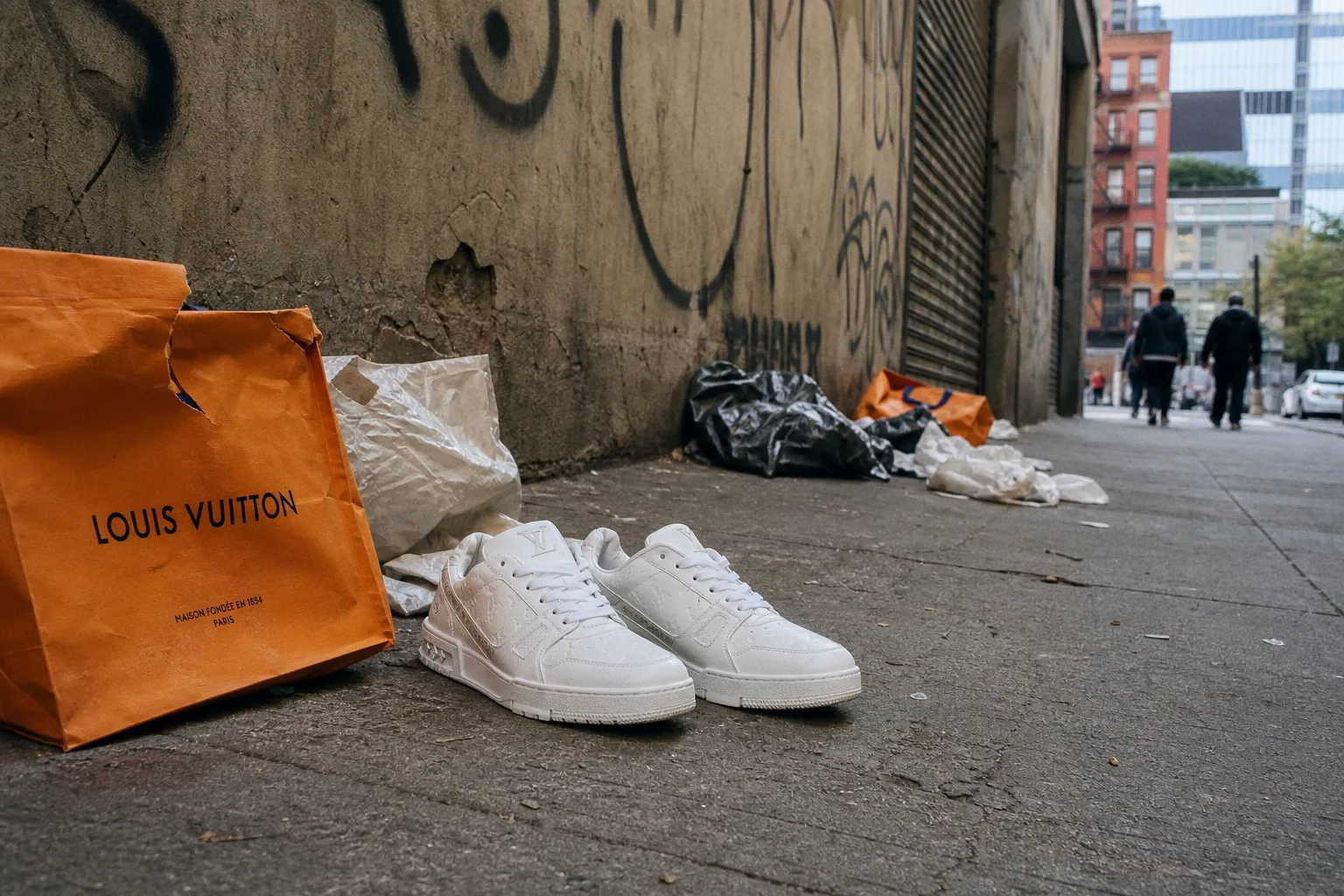
Contemporary streetwear brands have lost their hip-hop soul
Streetwear didn't get co-opted by luxury. Luxury walked in, sat down on the couch, and changed the locks.
The numbers tell a blunt story. The global sneaker resale market now runs into the billions. StockX and GOAT aren't sneaker shops — they're commodity exchanges dressed in sneaker boxes. Markup on "hype" releases routinely clears four figures, and what used to be a $50–$100 subculture uniform now carries a $500+ entry fee. We can dress this up in cultural analysis all we want, but the math is the math: the kids who actually invented this look got priced out of their own fit.
The Luxury Pivot: How High Fashion Absorbed Street Culture
The turning point — the actual hinge of the era — came in two moves, both within twelve months of each other.
First, the Supreme x Louis Vuitton collaboration in 2017. That wasn't a streetwear brand getting a co-sign from luxury. That was luxury holding the door open and saying, "Come in, but leave the attitude at the door." The collection was sold through LV boutiques, at LV price points, to a client list curated by the maison. The box logo didn't democratize the runway — it gave the runway permission to start wearing box logos.
Then, March 2018: Virgil Abloh — a kid who cut his teeth in Kanye's orbit and built his entire brand around hip-hop's cultural reference points — was appointed Artistic Director of Louis Vuitton Men's. That was the moment. Street culture didn't infiltrate the maison. The maison hired its first culture-native Creative Director. And it worked because the house understood exactly what it was purchasing: not just Abloh's sketches, but the entire reference library — the Off-White quotation marks, the Pyrex Vision lineage, the Chicago kid DJing house parties and curating mixtapes. They bought the playlist, not just the portfolio.
But here's the part that doesn't get enough airtime: when Virgil moved uptown, the streetwear floor didn't elevate with him. It hollowed out. The mid-tier labels that used to bridge the gap between mall brands and runway looks — BAPE, Undefeated, early Stüssy — got caught in a brutal squeeze. Too expensive to be authentic, too cheap to be luxury. They became cosplay.
The Resale Economy and the Death of Accessibility
Let me be specific about accessibility, because this is where the soul really left the building.
A Travis Scott Jordan, a Yeezy 350, an Off-White x Air Jordan 1 — these used to be obtainable. Sneaker release calendars were actual calendars, not war rooms. You'd line up outside Foot Locker, try your luck on the SNKRS app, either cop or eat. Now the entire release infrastructure has been reverse-engineered by bots running on server farms. Resale platforms complete the arbitrage in real time. The original buyer — the kid in the Bronx who actually had a reason to rock the Jordan 1 — is now competing with a hedge fund intern in Shanghai running a sneaker botnet.
The resale economy isn't a side effect of streetwear's success. It is streetwear's terminal phase. When a 17-year-old in Queens has to choose between a $1,200 pair of dunks and a week's groceries, the culture didn't grow — it relocated. And the people who got relocated weren't the ones who should have been there in the first place.
The kids who got priced out of the Travis Scott drop cycle didn't vanish. They migrated. Some went deep vintage, hunting deadstock in estate sales and Goodwill bins. Others drifted sideways into the outdoor drop economy, where the same scarcity playbook got applied to trail runners, shell jackets, and Salomon XT-6s — a parallel ecosystem operating on nearly identical mechanics. The same hype DNA, the same bot wars, the same resale arbitrage, just applied to a different silhouette. If you want to see how that adjacent drop culture built its own resale infrastructure, the outdoor drop ecosystem is a clean case study. That's not a pivot. That's an exile.
From Tour Merch to Corporate Capsules: The Travis Scott Effect
Travis Scott didn't invent artist merch. He industrialized it.
Before Cactus Jack, tour merch was a t-shirt, a hoodie, maybe a fitted cap with the tour logo screen-printed on the back. Functional. Affordable. Sold at the venue. Now look at what a single release cycle looks like for an A-tier rapper: a Travis Scott x McDonald's collaboration in 2020 — a full meal-deal redesign, a custom nugget sauce, and Cactus Jack packaging that briefly turned the largest fast-food chain on earth into a sneaker-drop queue. Then the Dior collaboration. Then the Nike SNKRS drops that crashed servers globally. Then the Dior x Air Jordan 1 — a $2,000 retail shoe whose resale multiples on Day One became their own news cycle, before the wider public ever got a real look at the thing.
| Era | Item | Price Point | Buyer | Cultural Function |
|---|---|---|---|---|
| Pre-2015 tour merch | Screen-printed tee, hoodie | $25–$60 | The actual fan in the building | Identity marker, in-room solidarity |
| 2018–2020 artist capsule | Branded hoodie, custom sneaker | $150–$400 | Fan + hypebeast crossover | Status symbol, social currency |
| 2021+ corporate collab | Dior x AJ1, McDonald's x Cactus Jack | $1,000–$2,000 retail, multiples on resale | Resellers, collectors, brand investors | Financial instrument |
This is no longer merch. This is product placement with a melody attached.
And every artist with a top-40 placement is now running the same playbook. Pop Smoke posthumous drops. Playboi Carti capsule after capsule. Even underground acts are engineering "limited" vinyl pressings with QR-coded resale authentication. The artist isn't selling merch — they're issuing a security. And the fan isn't buying a shirt — they're buying exposure to a futures contract.
The tragedy here is what got lost. Tour merch used to be a physical handshake between artist and audience. You'd wear the shirt to the show, you'd see two hundred other people wearing the same shirt, you'd be in a room together. Now the shirt is a financial instrument and the room is a Discord server.
The Runway Integration: Hip-Hop Aesthetics Without the Grassroots
Look at any Paris Fashion Week front row from the past five years and you'll see what looks like a BET Awards afterparty. Rappers in custom Balenciaga. Rappers closing Balenciaga shows. Rappers walking for Gucci, Off-White, Kenzo. Hip-hop didn't get invited to the runway — the runway got repopulated by hip-hop.
That's not a complaint. That's just the visual record. A$AP Rocky sitting front row at Dior with Rihanna. Lil Baby in custom Rick Owens. Gunna walking for Balenciaga in 2022. The aesthetic migration is total. The question isn't whether hip-hop is at the runway — it's whether the runway still means anything now that it does.
Because here's the part that should worry the culture: the runway now consumes hip-hop aesthetics faster than hip-hop can produce them. A silhouette that originated in a Memphis block party gets photographed at Paris Fashion Week six months later, and by the time the kid in the neighborhood tries to cop it, it's already been re-issued as a $3,000 archival piece. The runway doesn't borrow from the culture anymore. It extracts.
This is the difference between Virgil Abloh sitting front row at a Kanye show in 2011 and Virgil Abloh presenting a Louis Vuitton collection in 2018. The first was participation. The second was acquisition. And acquisition has no loyalty clause.
Preserving the Culture: Can Independent Brands Reclaim the Soul?
I'm not here to eulogize. Streetwear isn't dead — that word gets thrown around too loosely, and it cheapens what's actually happening. What we're watching is a partition. The high-fashion tier absorbed what it needed, the mass-market tier commodified the rest, and the middle — where the actual soul used to live — got hollowed out into a thin corridor of independent labels operating on margins and reputation.
But the corridor isn't empty. It's just quieter.
Look at Carhartt WIP, Patta, Brain Dead, Online Ceramics, Cactus Plant Flea Market — labels that still root in the culture without performing it for a Vogue shoot. Look at independent presses in Lagos, Atlanta, and Brooklyn releasing capsule runs of fifty units, sold through Instagram DMs and pop-up shows in actual neighborhoods, not SoHo. Look at the vintage dealers who've built entire storefronts on the premise that the new era is unwearable and the old era is the only authentic reference left. None of them will ever close a Paris Fashion Week show. All of them are doing more for the culture than half the brands currently in Vogue.
The soul of streetwear wasn't in the silhouettes. It was in who could actually afford to wear them on a Tuesday.
That's the thesis, and I'm not interested in hedging it. The soul of streetwear was never the box logo, the limited drop, or the runway moment. It was accessibility. It was a kid in the Bronx rocking a Polo Sport fleece because it was what was available, and that choice becoming a cultural reference point that no brand could buy, no marketing team could engineer, and no luxury house could acquire. The moment a subculture's uniform becomes a financial instrument, the subculture stops being a subculture. It becomes a market segment.
The culture isn't dead. It's just been moved to a different zip code. And the people still doing the work — the independent brands, the vintage dealers, the artists who still sell merch that costs less than a parking meter — are the ones worth watching. Not the runway. Not the resale floor. The actual streets, where the silhouette was invented in the first place.