80s hip hop fashion was never just cheap sportswear
The lazy read on hip hop fashion 80's is that it was all tracksuits, shell toes, bucket hats, and whatever athletic gear a kid could afford off the rack. That version is clean, marketable, and wrong.
Darius Rollins, Chief Hip-Hop Critic & Culture Editor·Updated: July 15, 2026·16 min read
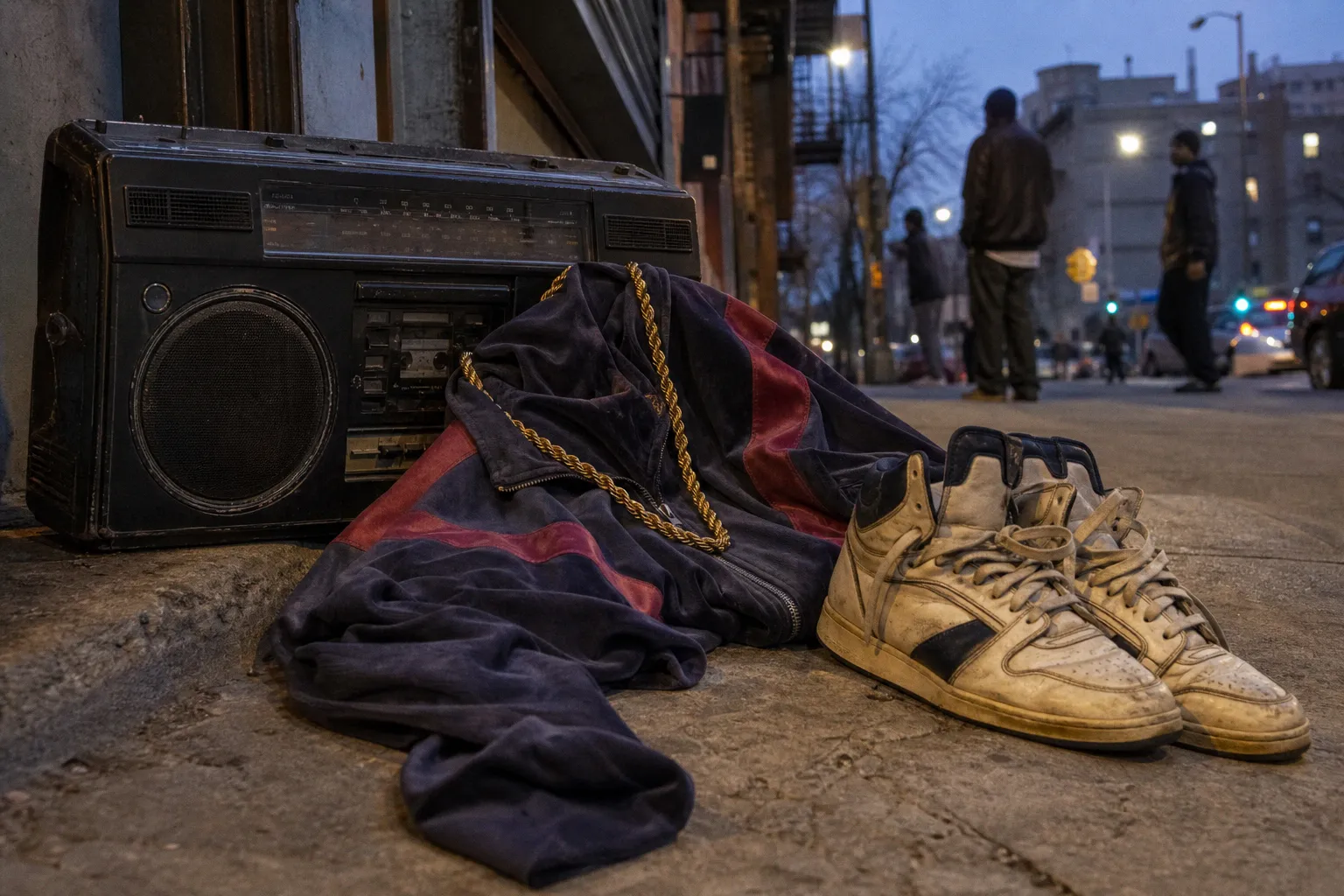
By the middle of the decade, the culture had already produced a 24/7 Harlem couture operation, a $1.6 million sneaker deal for non-athletes, gold rope chains that could run $10,000 to $20,000, and album-cover jewelry estimated at six figures per chain. Cheap sportswear? Please. That was only one layer of the fit. The real story was aspiration turned into silhouette, survival turned into branding, and street-level taste forcing corporate America and European luxury to look downtown, uptown, and across the bridge.
The Dapper Dan revolution: Harlem built the logomania blueprint
If you want to understand why 80s rap fashion history still matters, start at 43 East 125th Street, not a runway archive. Daniel “Dapper Dan” Day opened Dapper Dan’s Boutique in Harlem in 1982, and from there he rewired the relationship between hip hop, luxury, and visibility.
This was not a tailor making polite suits for polite rooms. Dapper Dan was cutting premium leathers and furs into custom pieces, then screenprinting luxury logos across them with the audacity of a man who understood something the luxury houses did not: the logo was no longer just a mark of origin. It was a weapon. Gucci, Louis Vuitton, Fendi, MCM — those marks became pattern, armor, declaration. The old luxury world treated logos like signatures. Harlem treated them like volume knobs.
And the boutique ran like the city’s pulse: 24 hours a day, 7 days a week for much of its life. That detail matters. A fashion house with bankers’ hours could not serve a culture moving on club time, studio time, street time, fight-night time. Mike Tyson, LL Cool J, Salt-N-Pepa — the client list tells you what the operation was. Dap was not chasing hip hop relevance after the charts validated it. He was dressing the people who were building the language in real time.
The myth says hip hop was wearing luxury wrong. The truth is sharper: hip hop understood luxury’s future before luxury did.
Dapper Dan’s 80s style was not authorized collaboration. Let’s keep that clean. These were bootleg designs, and the legal heat eventually shut the original boutique down in 1992 after litigation from Fendi. But culturally, the case had already been decided. The official houses had the trademarks. Harlem had the imagination, the clientele, the motion, and the nerve.
Dapper Dan did not knock on luxury’s door. He kicked it open, re-cut the coat, and made the logo speak fluent Harlem.
That is the part fashion history likes to sand down. The bootleg was not just a counterfeit object. In that context, it was critique, remix, and upgrade. Hip hop had already developed a sampling logic in sound: take existing material, flip it, loop it, recontextualize it until the original starts answering to you. Dapper Dan applied that same principle to clothing. The logo became the sample. The leather jacket became the beat. The street became the A&R.
And because hip hop is never only about the garment, the fit carried social information. A custom Dap piece told you the wearer had money, access, nerve, taste, and proximity to a very specific network. You could not just walk into a mall and buy that energy. You had to know where to go, what to ask for, and how to wear it without the clothes wearing you.
That is why the “cheap sportswear” line collapses fast. Sure, athletic brands mattered. But the top end of the culture was already spending real money on one-of-one pieces that luxury houses would later imitate, sanitize, and sell back at museum prices.
Gold was not accessory. Gold was currency with a beat behind it
The rope chain was not a cute detail. It was economics around the neck.
Authentic dookie rope chains in the mid-to-late 1980s, often sourced through Manhattan’s Diamond District, typically cost between $10,000 and $20,000. That number should kill the cheapness myth on contact. Ten racks in the 80s was not casual flex money. That was a car. That was rent stretched across years in some neighborhoods. That was a declaration that rap income, street income, DJ income, hustler income, however tangled the streams, could be converted into portable status.
Then look at Eric B. & Rakim on the cover of Paid in Full, released July 7, 1987. Those heavy gold chains were not background styling. They were part of the thesis. Jeweler Ben Baller has estimated each chain at around $100,000. Even if you do not know the exact weight or karat purity — and we should not pretend we do — the visual message is undeniable: this was not poverty cosplay. This was rap presenting itself as a new power class.
There is a reason that cover still hits. Rakim’s pen game changed MCing, but the image around the music also changed the math. The suits, the money phone energy, the gold, the controlled stare — it said rap was done asking permission to be perceived as valuable. It would establish value through presence.
Gold in 80s hip hop clothing and styling worked on multiple frequencies:
1. It made success visible from a distance. In a pre-Instagram era, the chain was the notification. You saw it in the club, on the block, on stage, in magazine spreads, on album covers. No caption needed.
2. It translated cash into permanence. Money could disappear. A chain had weight. You could hold it, pawn it, pass it, protect it. In neighborhoods where institutions had not exactly earned trust, gold carried a certain brutal logic.
3. It linked rap to older status traditions while mutating them. Nameplates, medallions, rings, ropes — these were not invented by rap, but rap scaled them, stacked them, and made them central to the artist’s visual identity.
4. It created competitive pressure. Hip hop has always been a sport hiding inside an art form. The chain became another stat line. Bigger, heavier, cleaner, rarer. A box score for the neck.
This is where cultural critics sometimes get uncomfortable, because the jewelry was loud, and loudness gets misread as shallow by people trained to respect quiet money. But quiet money is a luxury of people whose status is already protected. Hip hop came from rooms where being unseen could get you erased. So the gold shouted. That was the point.
Run-DMC made Adidas understand the crowd was the contract
May 29, 1986: Run-DMC releases “My Adidas.” A record about sneakers, yes, but really a record about ownership of meaning. The group took a German athletic brand and turned it into a Queens uniform with global implications.
Then came July 19, 1986, at Madison Square Garden, when the crowd famously lifted their Adidas in the air. That moment was not just fan participation. It was market research with bass. Corporate America got to see, in one room, what hip hop influence looked like when it moved bodies and product at the same time.
By mid-1986, Run-DMC signed a historic $1.6 million endorsement deal with Adidas — the first sneaker endorsement deal for non-athletes. Not the first sneaker endorsement ever. Don’t twist the stat. But for musicians, for rappers, for artists outside the sports machine? That deal cracked the wall.
Before that, sneaker companies largely understood cultural authority through athletes. Basketball players. Runners. Olympic bodies. Clean lines, sanctioned competition, measurable performance. Run-DMC forced a new equation: what if the real performance was the concert? What if the court was the stage? What if a sneaker’s credibility came from how it looked under black denim and leather, not just how it handled a fast break?
The industry has been chasing that answer ever since.
| Cultural move | What it looked like in the 80s | What the industry learned |
|---|---|---|
| Artist-driven sneaker identity | Run-DMC wearing Adidas as uniform, not costume | Rappers could sell product without playing a sport |
| Crowd validation | Fans holding sneakers up at Madison Square Garden | The audience itself could prove demand in real time |
| Brand loyalty as song subject | “My Adidas” turning footwear into anthem | Product placement hits harder when it comes from lived culture |
| Streetwear as endorsement language | Laceless shell toes, tracksuits, black hats | Styling can matter as much as performance specs |
That deal is one of the cleanest examples of hip hop converting cultural cachet into corporate money without losing the thread. Was Adidas getting access to a movement it did not create? Absolutely. Was Run-DMC getting paid for influence they had already proven? Finally.
And this is where the modern rollout economy should show some humility. Today, every brand wants a rapper capsule, a sneaker seed list, a limited merch drop, a TikTok activation, a “community-first” campaign written by people who say community like it came from a deck. Run-DMC did not need that fog machine. They had a record, a look, a crowd, and a brand that got smart enough to cut the check.
Even outside fashion, every industry now understands the race to turn influence into infrastructure; you can see the same launch logic in tech when a hot company drops a free product to accelerate adoption, like this report on a French startup releasing a free inference tool across AI chips. The mechanics change. The play stays familiar: prove the audience, lower the barrier, capture the market.
Hip hop knew that play early.
The Lo-Lifes turned Ralph Lauren into street royalty
By 1988, Brooklyn gave us another chapter that does not fit the discount-rack version of retro hip hop style myths: the Lo-Lifes. Formed through the union of Ralphie’s Kids and Polo U.S.A., the collective built a whole identity around hoarding, wearing, and obsessively styling Ralph Lauren Polo.
This was not corporate collaboration. This was adoption by force of taste.
Polo was aspirational in a very specific way. It sold a fantasy of old money, country clubs, ski slopes, sailing culture, equestrian leisure — basically everything the inner city was told it did not own. The Lo-Lifes took that fantasy and wore it in Brooklyn with a different posture. Suddenly the bear, the crest, the flag sweater, the rugby, the jacket, the color-blocked outerwear — all of it became street-coded. The brand’s intended story got hijacked by people with better styling instincts.
That is one of hip hop fashion’s great powers: it can change the meaning of a garment without changing a stitch.
A Polo piece in a Ralph Lauren campaign might whisper inheritance. On a Lo-Life, it spoke conquest. It said the country club dream had been raided, remixed, and brought back to the block. The clothes became trophies, but also language. You could tell who had knowledge by how they layered, which pieces they chased, how rare the colorway was, whether the fit looked collected or merely purchased.
The difference matters. Hip hop has always punished people who buy the signifiers without understanding the code. That was true then, and it is still true now. You can have the jacket and still not have the fit. You can have the archive and still look like a mannequin with a reseller invoice.
For the Lo-Lifes, 80s hip hop clothing brands were not just brands. They were territories. Adidas had Queens energy through Run-DMC. Dapper Dan had Harlem luxury mutation. Polo became Brooklyn obsession. These were maps of taste, neighborhood identity, status hunger, and competitive collecting.
And again: none of this reads as “cheap sportswear” unless you are committed to missing the point. This was expensive aspiration, sometimes legally clean, sometimes not, often risky, always intentional.
High fashion was watching earlier than it admits
High fashion did not wake up in the 2000s and discover rap because a few front-row invitations got handed out. The gaze started much earlier. By the late 1980s, designers were already pulling from hip hop’s visual language. Isaac Mizrahi sent models down the runway in black catsuits, heavy gold chains, and nameplate-inspired belts in 1988. That is not a minor footnote. That is the fashion establishment translating street-coded signals into runway vocabulary while the culture was still being dismissed in polite editorial rooms.
This is the loop that keeps repeating: hip hop innovates under pressure, fashion extracts under lighting, then the mainstream calls the runway version “elevated.”
No, beloved. The elevation happened before the invitation.
The street had already solved silhouette. Oversized outerwear. Stacked jewelry. Branded repetition. Athletic pieces worn as lifestyle pieces. Luxury logos blown up past subtlety. Nameplates as identity. Sneaker uniformity as group signal. The runway did what runways often do: it reframed the evidence and charged admission.
That does not mean every designer was stealing with no eye or respect. The exchange between high fashion and hip hop has always had complicated moments — admiration, appropriation, collaboration, correction, exploitation, reconciliation. But the timeline matters. Hip hop was not waiting to be validated by high fashion. High fashion was already studying hip hop because the streets had energy the ateliers could not manufacture on command.
The runway did not invent hip hop luxury. It learned to photograph it under better lights.
The irony is that the same elements once treated as excessive became central to global fashion language. Logomania? Standard luxury playbook. Artist capsules? Every brand wants one. Sneakers as cultural currency? The resale market built a cathedral around that. Gold chains and nameplates? Eternal. Tracksuits? Perennial. Streetwear silhouettes? Luxury houses have been dining off that plate for decades.
So when someone says 80s hip hop fashion was basic, what they usually mean is they only recognize fashion once an institution blesses it. That is not analysis. That is gatekeeping with a press badge.
The cheapness myth survives because it is useful
Let’s talk about why this bad read keeps breathing.
Calling 80s hip hop style “cheap sportswear” does a few convenient things. It makes the culture seem accidental instead of strategic. It frames rappers as consumers rather than designers of meaning. It lets luxury houses pretend they invented the very visual codes they spent years ignoring, mocking, or litigating. And it turns working-class creativity into a mood board without giving it authorship.
The actual record is messier and more powerful.
Dapper Dan’s Boutique operated from 1982 to 1992, building a custom luxury language out of bootleg logos, premium materials, and Harlem clientele. Run-DMC turned Adidas into a rap uniform and secured a $1.6 million deal that proved artists could move sneakers like athletes. Gold rope chains carried real economic weight, with common high-end pieces running five figures and iconic album-cover jewelry reaching legendary valuations. The Lo-Lifes treated Polo as collectible armor. High fashion began absorbing hip hop aesthetics before the decade was even over.
That is not a side note to fashion history. That is fashion history with drums.
The mistake is assuming cheapness because some garments came from sportswear. But sportswear in hip hop was never only about price. It was about movement, recognition, crew identity, stage readability, and democratic access. A tracksuit could be practical and symbolic. A sneaker could be everyday wear and sacred object. A bucket hat could be simple and still become iconography when worn by the right MC with the right stance.
Hip hop’s genius was never just buying expensive things. Any fool with budget can do that. The genius was in recombination: taking athletic wear, luxury logos, jewelry, prep brands, street tailoring, and neighborhood codes, then making them speak in one visual language.
That language had grammar:
- Scale: bigger chains, bolder logos, oversized silhouettes, louder contrast.
- Repetition: crews dressing alike, brands becoming uniforms, logos becoming rhythm.
- Customization: one-of-one pieces, altered fits, personalized jewelry, nameplates.
- Context switching: country club garments on Brooklyn blocks, European logos in Harlem nightlife, performance sneakers on rap stages.
- Defiance: wearing aspiration without asking whether the old gatekeepers approved.
That is why the best 80s looks still hold. They were not trend-chasing. They were identity systems.
What the 80s still teaches today’s streetwear economy
Modern streetwear loves to call everything a “drop,” as if scarcity alone can carry meaning. It can’t. Scarcity without story is just inventory management with a superiority complex.
The 80s model had deeper stakes. The best pieces were connected to place, risk, music, and community. A Dapper Dan jacket meant Harlem innovation and legal danger. Run-DMC’s Adidas meant Queens pride becoming corporate leverage. A heavy rope chain meant money converted into visible permanence. Polo on the Lo-Lifes meant aspiration seized and re-authored. These were not empty products floating in a hypebeast vacuum.
Today’s artist merch and sneaker collaborations often miss that. Too many capsules are just logo swaps: rapper name here, brand mark there, artificial scarcity on top, resale chatter by noon. No point of view. No silhouette worth remembering. No cultural thesis beyond “limited quantities available.”
That is the difference between a drop and a movement.
The 80s did not have the modern infrastructure — no Shopify countdowns, no SNKRS app heartbreak, no Discord cook groups, no influencer unboxing industrial complex. But it had something harder to fake: lived authority. The clothes came out of scenes where people were battling for visibility, dignity, territory, and joy. The fashion had consequences because the culture had consequences.
And that is the standard. Not nostalgia. Standard.
If a modern rapper wants to build a line that lasts, the lesson is not “make it look like 1986.” That is costume work. The lesson is to understand what those artists and style architects did structurally. They turned personal codes into public demand. They made brands adapt to them. They used clothing as an extension of the music’s argument.
That is why hip hop fashion 80's remains undefeated as a case study. It was not polished in the corporate sense. It was sharper than that. It had dirt under the nails and gold on the wrist. It understood that a logo could be stolen, a sneaker could become scripture, and a chain could say what a press release never could.
The verdict
The “cheap sportswear” myth is not just inaccurate. It is disrespectful to the intelligence of the culture.
Yes, 80s hip hop wore athletic gear. Proudly. Brilliantly. But it also built bootleg couture, forced the first major non-athlete sneaker endorsement, made jewelry into portable power, turned prep fashion into Brooklyn mythology, and gave high fashion a visual vocabulary it is still monetizing.
So let’s retire the lazy caption. 80s hip hop fashion was not cheap sportswear. It was luxury theory from the block, brand strategy before the decks, and cultural authorship stitched in leather, gold, suede, nylon, and nerve. The industry did not make it valuable. The culture did — and then the industry spent the next forty years trying to catch up.