Hip hop fashion clothes are losing their rebellious edge
The number that should make every streetwear head sit up: $200 billion. That's the estimated value of the global streetwear market in 2023, per The Business of Fashion — a figure so massive it makes…
Darius Rollins, Chief Hip-Hop Critic & Culture Editor·Updated: July 11, 2026·11 min read
Hip hop fashion clothes are losing their rebellious edge
The number that should make every streetwear head sit up: $200 billion. That's the estimated value of the global streetwear market in 2023, per The Business of Fashion — a figure so massive it makes the baggy-denim-and-Kangol era look like a basement mixtape compared to what's spinning in the corporate suite today. Hip hop fashion clothes haven't disappeared. They've been absorbed, repackaged, and resold back to the very kids who once used them as a uniform of refusal. The edge didn't die in a single dramatic moment. It got whittled away, drop by drop, collaboration by collaboration, until what we're left with is a market that looks revolutionary on a mood board and behaves like a hedge fund on a quarterly call.
I'm not writing this from a tower. I still own my Stussys from 2004. I've waited in line for Jordans in the rain. I've watched Run-DMC lace up the adidas Superstar and understood, in real time, what it meant for a group from Hollis to bend a German athletic brand to their language. So when I say the lane has shifted, I'm not theorizing. I'm watching a thing I love get negotiated out of its own inheritance.
The 2017 Pivot: When Supreme Met Louis Vuitton
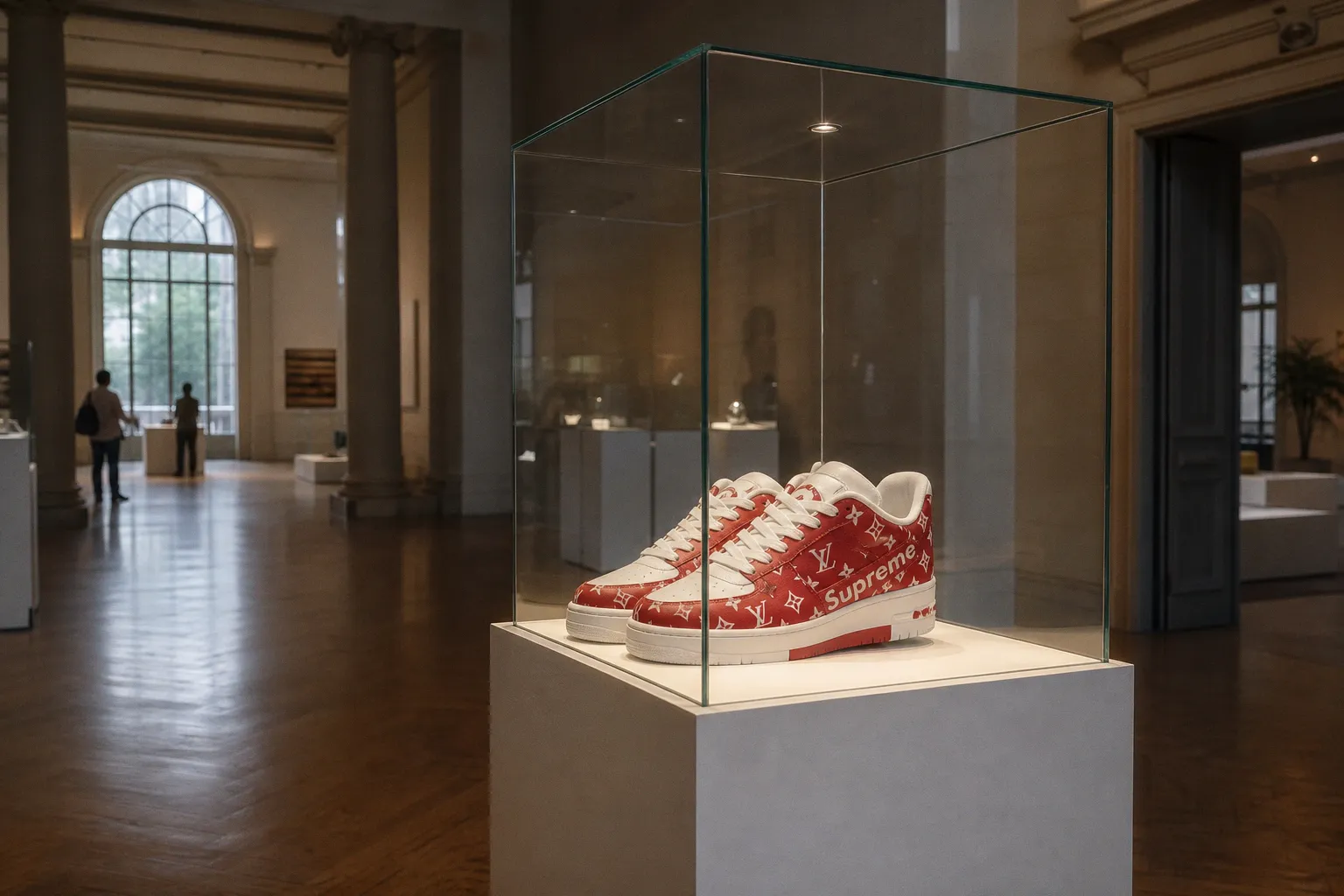
If you want a clean timestamp for when the culture flipped, mark it: 2017. That fall, Louis Vuitton — the most monogrammed house on the planet — walked a Supreme collaboration down the runway. Box-logo red. LV monogram fused with the italic Futura Heavy Supreme wordmark. James Jebbia's downtown skate-shop DNA stitched into the maison that once sold steamer trunks to European aristocracy. The collection didn't drop quietly. It detonated.
What made that collab seismic wasn't the product. It was the message. For thirty-plus years, Supreme had built its entire identity on scarcity, irony, and a sneer at the establishment. The brand's whole operating thesis — fuck you, pay me — depended on staying outside the walls. The moment Virgil Abloh, Kim Jones, and the LVMH apparatus absorbed Supreme into the runway calendar, the walls came down. And the kids in line didn't riot. They re-upped their CVCs.
The Louis Vuitton x Supreme drop didn't sell out a collection. It sold out the idea that streetwear could ever again stand fully outside the luxury system.
That moment is the hinge. Everything in hip hop fashion clothes that came after — every Off-White x Nike, every Travis Scott x Jordan, every Yeezy season built around architectural minimalism and $220 price tags — runs through that 2017 runway. The blueprint was set: rebellion as a limited capsule, rebellion as a press release, rebellion as a fiscal quarter. The streetwear grammar got licensed. The accent got gentrified. And the cultural cachet that took three decades to build got folded into a Q4 revenue line.
From Counter-Culture to a $200 Billion Commercial Giant
The runway moment was the spark. The market is the blaze. The Business of Fashion pegged the global streetwear market at roughly $200 billion in 2023, and every credible industry tracker since has confirmed the trajectory: up, and steeply. That number is bigger than the GDP of most countries. It's bigger than the recorded-music industry at its mid-2000s peak. And it's bigger, by a wide margin, than the gross of every independent streetwear label that built the genre's original wardrobe combined.
| Cultural Era | Dominant Aesthetic | Price Point | Power Center |
|---|---|---|---|
| 1980s–early 90s (Golden Age) | Gold rope chains, Cazal glasses, leather Timbs, raw denim | Working-class to mid | Artist + neighborhood stylist |
| Mid-90s to early 2000s (Bling Era) | Oversized jerseys, baggy Sean John, custom Air Force 1s, platinum fronts | Mid to aspirational | Artist + bespoke tailor + jeweler |
| 2000s–early 2010s (Streetwear Crossover) | Bape, Stüssy, early Supreme, slim vs. baggy debate, Jordan retros | Mid to premium | Brand + streetwear boutique |
| 2017–present (Luxury Fusion) | LV monogram, Off-White quotation marks, Travis Scotts, Yeezy Foams | Premium to ultra-luxury | Maison + corporate conglomerate + celebrity IP |
Look at that last row. The power center moved. It used to live on the block, in the barbershop, in the studio. Now it lives on the 22nd floor of an LVMH building in the 1st arrondissement. That's not a corruption — that's a transfer of gravity. And once gravity moves, everything that used to fall up starts falling down.
For a long stretch, hip hop fashion clothes functioned as a kind of cultural semaphore. You could read a person's politics, neighborhood, and crew affiliation from their silhouette: the length of the tee, the lacing pattern on the sneaker, the way the chain sat on the chest, the cut of the WorkWorld jacket. That semiotic density is what made the wardrobe dangerous. It was an argot the mainstream couldn't parse — and crucially, didn't want to. Once LVMH learned to parse it — and price it — the argot went mainstream. The signal became noise. The uniform of refusal became the uniform of aspiration.
And the 90s rap style canon — the baggy Hypercolor tees, the Coogi sweaters, the door-knocker rings, the all-white Air Force mid — got curated into museum exhibits and auction blocks. The thing the kids wore because it was theirs is now the thing collectors pay five-figure sums to relive. The wardrobe got archived while it was still warm.
The Pharrell Effect and the Corporate Creative Director
In February 2023, Louis Vuitton named Pharrell Williams its Men's Creative Director — the second Black man, after Virgil Abloh, to hold that kind of throne at a legacy house. Pharrell isn't just a musician. He's been a cultural operator since the early '90s: Billionaire Boys Club, Ice Cream, the BBC split with Nigo, the BAPE era, the "Frontin'" uniform, the endless sneaker resumés. He's the closest thing hip hop has produced to a hybrid executive-artist — a man who can sit across from Bernard Arnault and still know what a Bapestick hoodie means to a kid in Atlanta. So when he got the LV seat, the headlines read as victory. A milestone. A long-overdue correction.
I read it as something else. A capstone. Because here's what the appointment actually teaches the market: how to translate streetwear vocabulary into luxury revenue without diluting either. Pharrell didn't democratize the maison. He gave the maison the dictionary. The house now knows how to say "drip" in quarterly-earnings language. The artist learned the P&L. The maison kept the architecture. Everybody wins on the press release, and nobody's power actually moves.
That's the Pharrell Effect, and it's bigger than one man. It's a template. Every major house now has a version of the playbook:
- Hire the rapper-adjacent polymath.
- Give them a title that sounds like ownership.
- Let them ship a few street-coded capsules.
- Watch the resale market multiply the price of admission.
- Collect.
The aesthetic gets imported. The hierarchy doesn't. Hip hop fashion clothes have entered the era of the corporate creative director — a role that looks like a seat at the table but functions as a translation layer. And translation, by definition, strips the source language of its native friction. You can't quote Raekwon in a luxury showroom and still feel the chill of Wu-Tang Forever on a Staten Island stoop. The quote is real. The temperature is gone.
Hypebeast Culture: Exclusivity Over Individual Expression
Let's talk about the resale economy, because that's where the soul of the wardrobe is now being arbitrated. StockX and GOAT didn't just digitize sneaker transactions — they turned hip hop fashion clothes into a tradable asset class. The 2015 Jordan 1 Bred that retailed at $160 now clears four figures on a clean day. Travis Scott Jordan drops routinely hit resale numbers that would make a small-cap stock blush. Yeezy Foams, after their official retirement, became instant graveyard inventory. The "drop" isn't a release. It's an IPO. And the kids with the fastest bots get the allocation.
| Drop Model | Access | Resale Behavior | Cultural Function |
|---|---|---|---|
| 1990s general release | Walk into Foot Locker | Minimal, retail-only | Identity signal |
| 2000s limited collab | Boutique raffle, line culture | Moderate, 2–3x retail | Subcultural marker |
| 2010s hype drop | SNKRS app, draw-based | Aggressive, 5–10x retail | Status flex + investment |
| 2020s hypebeast era | Bot warfare, restock monitors | Extreme, 20x+ for grails | Pure asset class |
Three things happened in that transition, and they happened fast.
1. Scarcity replaced abundance as the dominant grammar of cool. The more impossible a piece was to obtain, the more it meant to obtain it.
2. The wardrobe stopped being something you wore and started being something you held. Inventory, not identity.
3. The kids who actually needed the clothes — the ones for whom a fresh pair wasn't a flex but a baseline — got priced out of their own culture.
That's the quiet crisis inside hip hop fashion clothes right now. The pieces are still here. The silhouettes are still here. The oversized hip hop outfits, the throwback jersey, the custom Forces — all still in rotation. But the relational logic has flipped. Wearing used to mean something about who you were. Now wearing mostly means something about what you spent. And once the metric is spend, not signal, the wardrobe stops being a language and becomes a ledger.
I don't blame the buyers. FOMO is a feature in this market, not a bug. I blame the architects — the brands, the platform middlemen, the celebrity stylists monetizing scarcity — who learned they could extract more value from a thing by making it rare than by making it good. The result is a culture that looks like abundance on Instagram and behaves like a famine on the ground. The flex is rented. The culture is mortgaged.
The Underground Resistance: Where the Edge Still Lives
Now — and I want to be precise here, because the doomers are loud and they're wrong — the edge isn't dead. It just migrated. You won't find it on the front row of a Paris Fashion Week show. You won't find it in a Pharrell lookbook. You won't find it in a resale screenshot on a Twitter timeline. You find it where it always survived when the mainstream got comfortable: in the underground.
Independent streetwear labels still operate on the old playbook. Small runs. Tight crews. Refusal to scale. There are designers in Brooklyn, in Atlanta, in Los Angeles, in London, in Lagos, in Tokyo, in Kingston — building hip hop fashion clothes that still function as uniforms of refusal. They don't have LVMH distribution. They don't need it. Their drops move through DMs, basement pop-ups, freight-elevator shows, and word-of-mouth that predates the algorithm. The silhouettes in those rooms still carry the old semiotic density — you can read the politics, the block, the allegiance — because the audience is small enough to still speak the language.
The rebellious edge didn't vanish from hip hop fashion. It got pushed out of the press release and back into the basement — and that's exactly where it always survives.
The same is true in rap itself. Plenty of artists at the underground and mid-tier level still use the wardrobe as a tool of opposition — not as a luxury flex, but as a coded statement. Workwear. Military surplus. Hand-dyed pieces. Deconstructed silhouettes. Modified religious iconography. Custom jewelry that reads as scripture, not as status. These are choices, not aesthetics. They read as dissent because they refuse to read as anything else.
The mainstream luxury fusion isn't going anywhere. The $200 billion isn't shrinking. Pharrell is going to keep shipping LV collections. Travis is going to keep resetting the resale curve. The hypebeast economy is going to keep treating sneakers like securities and streetwear brand culture like a quarterly earnings call. That's the dominant phase of hip hop fashion clothes now, and pretending otherwise is a waste of breath.
But culture doesn't move in one direction. It spirals. And every spiral has an undertow. What I'm watching for — and what you should be watching for — is the moment the next generation decides that wearing what's scarce isn't the same as wearing what means something. When that flip happens, and it will, the corporate playbook won't have an answer. You can't IPO a feeling. You can't tokenize a silhouette. You can't put a luxury markup on a uniform that was never meant to be sold.
Luxury rap fashion bought the building. The culture still owns the basement. And basements, historically, are where the next movement rehearses before it takes the stage.
That's where hip hop fashion clothes are headed next. The rebellion isn't behind us. It's just waiting in a different line.