Freestyle rap lessons I learned from 30 days of cyphers
Here's the thing nobody in the barbershop debate about freestyling wants to admit: the people who look effortless on a Thursday night cipher have done the work. They just don't broadcast it.
Darius Rollins, Chief Hip-Hop Critic & Culture Editor·Updated: July 12, 2026·9 min read
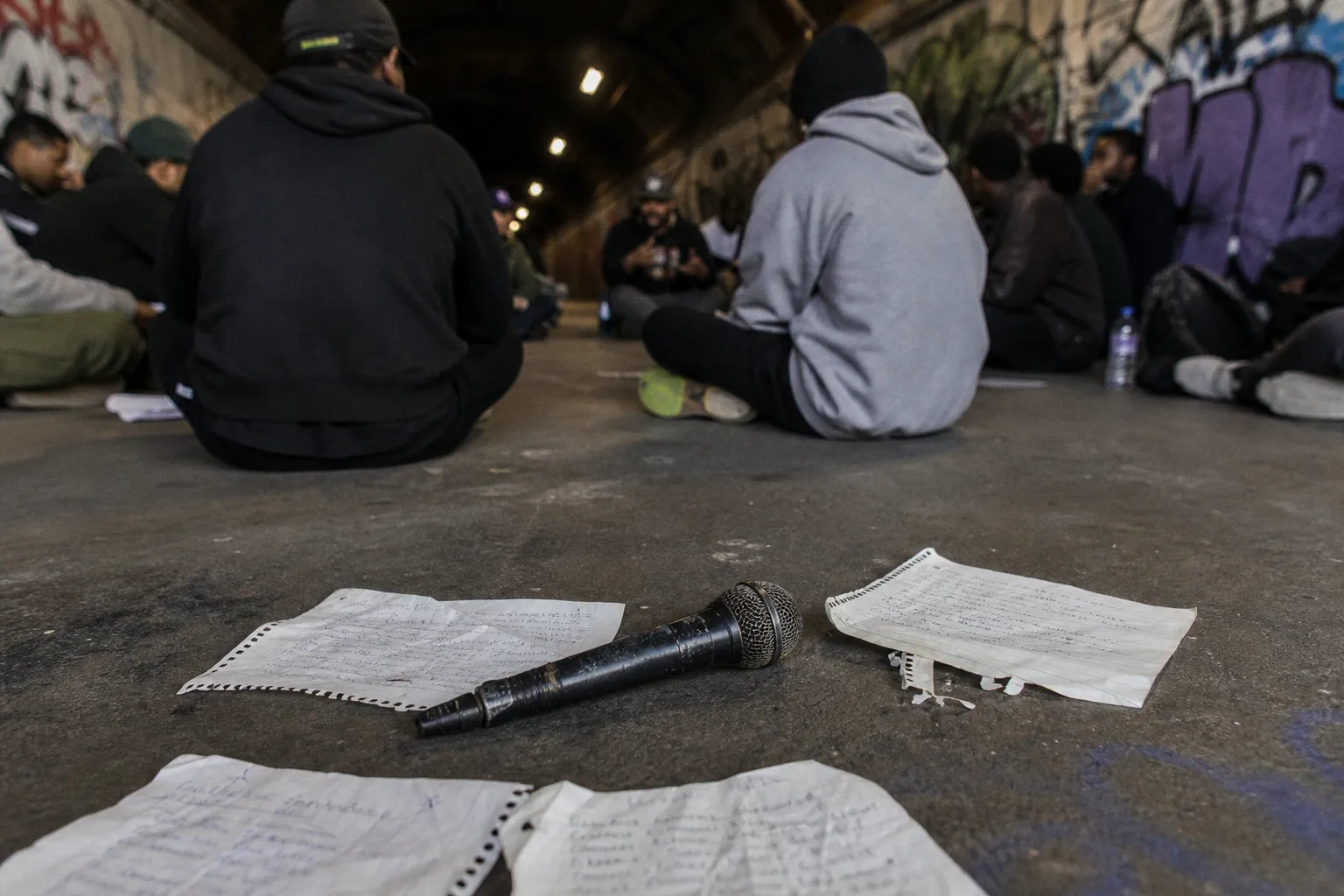
Freestyle rap lessons I learned from 30 days of cyphers
Your rhyme bank is a muscle, not a journal
The first myth I had to kill was the idea that a rhyme bank meant keeping a notes app full of multisyllabic assonances. That's reference material. Useful, sure, but not the engine. The real rhyme bank lives in your ear and your throat — it's the connective tissue between words you've heard a thousand times and the muscle memory to stack them under pressure.
What thirty days forces you to do is compress that database. You stop cataloguing rhymes by meaning and start cataloguing them by sound. "Came," "flame," and "lame" stop being separate entries; they become a neighborhood. Your brain starts scanning in clusters. That's not something you read about — it's something that happens when you've burned through six bars of a hot beat and your tongue has to find "flame" before the snare hits.
The reps that built this weren't glamorous. A lot of it was freestyling alone in the car, over random beats, forcing myself to land on a multisyllabic rhyme before the 16-bar mark. Some nights I got there. Most nights I didn't. By day fifteen, the clusters were denser. By day twenty-five, I could hear three possible rhyme paths before I'd finished the first bar. That's the bank. It's not stored — it's trained.
A rhyme bank isn't something you write down. It's something your mouth learns to reach for.
The 90 BPM gospel beginners won't accept
Every freestyle tutorial wants to sell you complexity. Multi-syllabic schemes, internal rhymes, double entendres. Cool. Save it for the third month. The actual lesson from thirty days in the cipher is this: stay on beat, or nothing else you do matters.
Hip-hop runs on 4/4 time as the default, and for a beginner trying to build improvisational stamina, the recommended tempo window — roughly 90 to 100 BPM — isn't a suggestion. It's a survival range. Slower beats give your processing brain time to scan the rhyme bank. Faster beats punish anyone who hasn't built the wiring yet.
What I learned, sometimes painfully, was that flow and rhythm aren't garnish on a freestyle — they're the dish. A simple rhyme delivered clean on the beat will always outcook a brilliant line that lands late. The circle knows it. The beat knows it. Your pen game means nothing if your pocket is off.
I started tracking my own BPM sweet spot during week two. Anything under 85, I sounded like I was rapping underwater. Anything over 105, I started gasping for syllables. The 90–100 window gave me just enough drag to think and just enough push to feel the pressure. That's the lane. Live in it until your ear demands more, and don't let the TikTok rappers with their 140 BPM acrobatics gaslight you into thinking you're slow. You're not slow. You're training.
The cipher doesn't care about your feelings
This is the part no one writes about in the glossy "freestyle rap tips" pieces. The circle is a court, and you're on trial. Performance anxiety isn't a side effect of freestyling — it is freestyling. The day you step in front of two or more peers and the beat drops, your body lights up like it just walked into a dark alley. Heart rate spikes. Working memory narrows. The thing you practiced in the car sounds like a foreign language coming out of your mouth.
Thirty days of cyphers doesn't cure that. It recalibrates it. By day ten, I could feel the surge coming before my first bar and ride it instead of fighting it. By day twenty, the anxiety was still there — it just stopped eating my verses.
The trick wasn't confidence. It was acceptance. The circle is going to judge you. Somebody is going to smirk when you fumble a rhyme. Somebody is going to nod when you land one. Both reactions are data, not verdicts. The rappers who actually level up are the ones who stop treating every cipher like an audition and start treating it like a lab. I'm not up here to prove I'm the best in the room. I'm up here to find out what my mouth does when my brain is on fire.
That's the mindset shift that moves the needle for real. Not "believe in yourself." Just: get curious about the panic. The moment you start observing the anxiety instead of obeying it, your working memory opens back up and the rhymes start flowing again. Most freestyling failures aren't talent failures — they're nervous-system failures.
Strategic stalling: the art of buying a half-second
Here's a technique the old heads know and the beginners stumble into by accident: filler phrases. The "yeah," the "uh," the "know what I'm saying," the elongated "let me…" that hangs in the air while your brain runs the scan.
The mistake is treating fillers as a crutch. They're not. They're a tool. A well-placed "y'all know what it is" doesn't signal weakness — it buys your cognitive system roughly 400 to 800 milliseconds of processing time. That's enough to land on a rhyme that otherwise would have evaporated.
The art is deploying them without losing the pocket. A filler that falls on the downbeat, attached to the rhythm, isn't a stall — it's a stylistic choice. A filler that arrives late, breathy and desperate, is a tell that your rhyme bank has run dry. Same sound, completely different read.
By week three, I'd built a personal kit that I rotated based on tempo:
- "Still" or "real" — a single-syllable anchor that sits clean on the downbeat and buys a half-bar.
- "Y'all know what it is" — a five-syllable runway that works at 90 BPM and below, where it sounds conversational, not frantic.
- A short laugh or exhale — sounds like style if you can shape it into the cadence; sounds like panic if you can't.
- "Let me…" — the highest-risk filler because it eats two beats; only works if you can already see the next rhyme waiting.
None of these replace a bar. They buy runway to find the right one. And once you stop being ashamed of them, your freestyles get longer, not shorter.
If your filler rides the beat, it's style. If it falls off the beat, it's panic. Same words, different pocket.
Eight bars is a marathon when your heart rate is at 160
The standard freestyle turn in a cipher runs somewhere between 8 and 16 bars. That number sounds small when you're reading it on a screen. It feels like a mountain when the beat is live and four people are watching you like you're one bar away from missing.
Here's what I didn't understand until I lived it: bar length isn't really about bars. It's about decision density. In a written verse, every line has been pre-decided. In a freestyle, you're making line-level decisions at roughly the speed of speech, under social pressure, with no rewind. Eight bars of that is genuinely hard. Sixteen bars is elite.
The reps that built my bar capacity weren't really about adding bars. They were about reducing the cost of each decision. After three weeks, I wasn't thinking harder — I was thinking faster. The rhyme bank scans were tighter. The filler deployment was cleaner. The cognitive load per bar dropped, which meant I could stack more of them before I hit the wall.
If you're a beginner working on improving rap flow, the honest target isn't "go for sixteen." The honest target is "stay in the pocket for eight without panicking." Most people can't do that on day one. I couldn't either. By day twenty-eight, holding a full eight-bar pocket felt like the new normal — like something I could actually rely on when the room was watching, not just something that happened by accident when I was alone in the car with the windows up. That's the metric that actually matters — not the longest verse you ever spit, but the most consistent one.
What thirty days actually changed — and what it didn't
Here's the scoreboard, no fluff.
What changed: my rhyme bank is denser, my flow at 90 BPM is cleaner, my performance anxiety is louder but more useful, and my filler game is intentional instead of desperate. I can hear three rhyme paths to any given word. I can hold a pocket for eight bars without my brain white-screening. I understand, finally, why the cipher is the actual classroom of hip-hop — not the studio, not the SoundCloud upload, not the studio session. The circle.
What didn't change: I'm not a freestyle savant. I'm not going to out-rap someone with a decade of circle reps. I still fumble multisyllabic stacks under pressure. I still lean on simple rhymes when the tempo climbs past 100 BPM. Thirty days doesn't make you a magician. It makes you a student with attendance.
If you're trying to learn how to freestyle rap, the only advice that survived my thirty days is the only advice the culture has ever really offered: get in the circle. Fall on your face. Come back. Do it again. The internet can give you tips on improving rap flow, on rap improvisation techniques, on building a rhyme bank, on freestyling for beginners who think they need a shortcut. There is no shortcut. There is just the cipher, the beat, and the reps that nobody sees.
That's the curriculum. The cipher is the syllabus. Everything else is commentary.